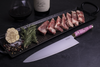
Fire · San Joaquin Valley, California
California Olivewood is dense and luminous, a wood long tied to nourishment and long life. Its element is fire. The grain shows more of its depth the more the knife is used, and Catalina is the knife you pick up most often: segmenting citrus for the table, shaping a garnish by hand. Olive is the wood of generosity, a good match for a cook who makes meals to share.
On the hardware: Naval Brass meets the olivewood's warmth and gathers its own patina with use. Nickel Silver brightens the grain against cool metal.
The knife
Catalina is the Aura California paring knife: a 4.5-inch blade of American-made CPM MagnaCut steel, hardened to 63-64 HRC and handcrafted in California. It is named for Santa Catalina Island, and for Saint Catherine of Alexandria, the patron saint of knife sharpeners. It is the knife you use off the board, in the hand, for hulling, peeling, segmenting and trimming.
The heritage
Twenty-six miles off the coast lies an island the Tongva people called Pimu. They lived there for eight thousand years, one of the longest continuous human histories in California. In the autumn of 1602, the explorer Sebastián Vizcaíno sighted the island from his ship on the eve of November 25th, the feast of Saint Catherine, and named it Santa Catalina for the saint of the day. Catherine of Alexandria was a scholar and a martyr, and old paintings show her with two emblems: a broken wheel and a sword. Over the centuries she became the patron saint of librarians, of philosophers, and of knife sharpeners. So the island that gives this knife its name also carries the patron of the sharpener's trade. Catalina is named for both.
The blade
Every Catalina starts with the same blade, and the blade starts with the steel. We use American-made CPM MagnaCut at 63-64 HRC because it holds a fine edge through demanding work, sharpens cleanly for decades, and resists corrosion without special care. It is a steel made to be used every day for a lifetime.
At 4.5 inches, Catalina is on the longer side for a paring knife: fine enough for detail work, with enough blade for real cutting. It is the lightest knife in the range, balanced slightly toward the handle so the tip feels light in the fingers. A thin spine and a sharp, pointed tip slide under skin and into the stem of a strawberry or the eye of a potato without tearing. The edge is ground to 15 degrees per side, a Western bevel finer than most paring knives, so it cuts cleanly through delicate skins. The bolster and pommel are finished by hand and help set the balance. The satin finish is polished so food releases instead of sticking.
The blade is the same on every Catalina. What changes is the handle: the material you choose, and the hardware that finishes it.
Specifications
| Blade length |
115 mm (4.5 in) |
| Blade depth (heel) |
23 mm |
| Total length |
8.5 in |
| Weight |
About 85 g (lightest knife in the range) |
| Hardness |
63-64 HRC |
| Steel |
American-made CPM MagnaCut |
| Bevel angle |
15° per side, Western |
| Spine thickness |
1.5 to 2 mm |
| Balance |
Toward the handle, light at the tip |
| Hardware |
Hand-finished bolster and pommel |
| Finish |
Polished satin |
| Origin |
Handcrafted in California, est. 2022 |